EPL Rupture
Additional Information
What has happened
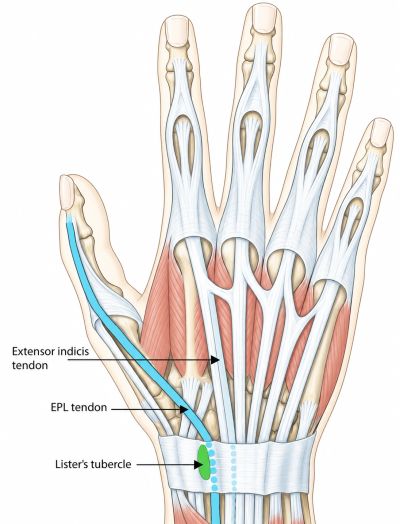
The extensor pollicis longus, usually shortened to EPL, is a thin, strong tendon. It runs from your forearm, hooks around a small bony bump on the back of the wrist on the thumb side, and attaches to the very tip of the thumb. Its job is to straighten the tip of the thumb and to lift the whole thumb back away from the palm.
When it ruptures, the thumb loses three things: the ability to point upwards, the ability to open widely around large objects, and the ability to hold rigid for a firm pinch.
Why the tendon snapped
It rarely gives way in a single dramatic accident. Much more often it has been weakening for some time.
After a wrist fracture. This is the most common cause. The tendon may have been bruised at the time of the injury. Slight irregularities on the healing bone can rub against it. And the swelling can reduce the delicate blood supply to the tendon inside its tight tunnel, so it weakens over weeks or months. The pattern is characteristic: the wrist feels fine after the cast comes off, and the thumb then stops lifting some weeks later.
Repetitive activity and inflammation. Long-standing inflammation of the tendon sheath thickens it, narrows the tunnel and increases friction until the tendon wears through. Rheumatoid arthritis is a common inflammatory cause.
Lister's tubercle. This is the bony bump the tendon hooks around, and it acts as a pulley. Any prominence, spur or fracture fragment there increases friction and wear.
Less common causes. A direct cut, a severe wrist sprain, a steroid injection close to the tendon, and conditions such as lupus or gout.
Spontaneous rupture. Usually in people over 70, where no clear reason is found.
How to recognise it
The rupture itself often feels like a sudden pop or snap, frequently without much pain. What follows is distinctive:
- You cannot actively lift the tip of the thumb, or bring the thumb back behind the plane of the hand. Rest your hand flat, palm down, and try to point the thumb tip at the ceiling. If it will not move, the EPL is the likely cause.
- You cannot straighten the last joint of the thumb against resistance, and sometimes not at all.
- Key pinch and grip are weak, because the thumb collapses rather than staying rigid.
- There may be mild swelling or bruising over the back of the wrist.
Diagnosis is made clinically, from that pattern of lost movement, together with an examination of the wrist. X-rays are used where there has been a previous fracture.
The one thing that makes this different
A ruptured EPL will not heal on its own.
Most of the conditions described elsewhere on this site can reasonably be watched. This one cannot. The tendon ends pull apart quickly and the gap fills with scar tissue, so waiting does not lead to recovery — it only makes the reconstruction harder.
That does not mean surgery is automatic. It means the choice is between having it reconstructed and adapting to a thumb that does not lift, rather than between having it treated now and having it treated later.
If you choose not to have surgery
Non-surgical management is used mainly for people who are frail, who have medical conditions that make surgery risky, or whose demands on the thumb are low and who are content to adapt. It involves a custom splint holding the thumb tip straight, and therapy to train other muscles to compensate.
Function can remain significantly impaired. This should be a considered choice rather than something that happens by default.
The operation
Tendon transfer is the usual operation and the most reliable solution — particularly for ruptures caused by a fracture or by wear, and for any rupture diagnosed weeks or months after the event.
A less critical tendon, the extensor indicis proprius or EIP, is taken from the back of the hand. It is one of two tendons that straighten the index fingertip. It is rerouted through tunnels under the skin and attached to the stump of the ruptured EPL. The EIP is chosen because it is the right size and strength, and because other tendons take over its original job without any noticeable loss to the index finger. In effect, the transfer gives your thumb a new motor.
Direct repair — stitching the two ends back together — is the ideal, but it is only possible if the rupture is very recent, was caused by a clean cut, and the tendon ends are still healthy. In practice this is rarely possible.
Tendon graft — bridging the gap with a piece of tendon taken from elsewhere — is used if the remaining EPL stump is too short or too damaged for a transfer. This is less common.
Whichever is done, dealing with the underlying cause is an essential part of the operation: smoothing any rough bone, releasing a tight or inflamed tendon sheath, or removing scar tissue. Without this, the repair or transfer is at risk of failing in the same way the original tendon did.
The operation is a day case, usually carried out under local anaesthetic. Local anaesthetic has a particular advantage here — it lets Miss Edwards set the tension of the transfer correctly with your participation, by asking you to move the thumb during the operation. Afterwards your wrist and thumb are held in a splint, which stays on for six weeks while the transfer heals.
What surgery can and cannot achieve
Tendon transfer restores functional thumb extension in the great majority of cases. The dropped thumb is corrected, most people regain full or nearly full extension of the thumb tip, pinch and grip strength improve substantially, and most people return to their previous work, hobbies and daily activities without major limitation.
Being realistic matters here too:
- Strength improves greatly but may not quite match the uninjured side, particularly for very forceful tasks. In published series, thumb extension strength ends up around a fifth lower than the other side (Ha et al., 2024).
- Full movement is usually achieved, though a slight limitation in the last few degrees of extension or bending can remain.
- Index finger extension strength is measurably lower than the other hand — around a fifth to a third lower — although the finger keeps near-normal movement and can still be straightened on its own (Lemmen et al., 1999; Ha et al., 2024).
- Some initial stiffness is normal and improves with therapy. Occasional aching with heavy use or weather changes can persist.
- The scars fade but remain visible, and scar tenderness usually settles.
- The nerves around the surgical site can be sensitive to cold, sometimes for a long time.
- It takes months for the transferred tendon to feel natural. Your brain adapts well, and the movement eventually becomes automatic, but it feels deliberate at first.
The risks
As with any surgery, there are risks: infection at the wound; rupture of the repair or transfer, which is why the splinting regime and the early restrictions matter so much; adhesions, where scar tissue tethers the tendon down and limits movement, sometimes needing further surgery to release it; stiffness of the thumb or wrist; injury to nearby nerves, causing numbness or a tender spot at the scar; incomplete correction; cold sensitivity around the scars; and complex regional pain syndrome, which is uncommon but recognised.
Published series of this operation are small, so most of these risks have not been given reliable percentages in the literature and are described in words rather than numbers.
Recovery
Recovery from an EPL tendon transfer is a marathon rather than a sprint. Expect three to six months or more for full functional return, and be prepared for it to need real commitment. Attending your therapy appointments and doing your home exercises several times a day is what determines the result. Pushing too hard risks rupturing the transfer; not pushing hard enough leaves you stiff.
Weeks 0 to 6 — protection and early motion. You will be in a specialised splint holding your wrist and thumb in a position that protects the transfer and keeps tension off it. It stays on for the full six weeks, almost constantly at first. Early controlled motion usually starts around weeks 3 to 4, under the strict guidance of your hand therapist. Swelling control matters throughout, and scar management begins once the incision is well healed. Most people are back to desk-based work at 3 to 4 weeks.
Weeks 6 to 12 — building motion and light function. The protective splint is modified or worn less, often only at night or during risky activities. Therapy shifts to actively regaining thumb extension, and gentle strengthening begins. Driving waits until the splint comes off at six weeks. Manual work usually takes 8 to 10 weeks.
Three to six months and beyond — strengthening and integration. Splinting is usually stopped, and strengthening becomes the main focus. Neuromuscular re-education matters as much as strength: your brain has to learn to use the transferred tendon for thumb movement instead of its original job. This is why the movement gradually stops feeling deliberate and becomes automatic. Therapy is then tailored to your own work and hobbies.
More information
The full detail, including the consent discussion, is in the patient information leaflet on this page.
The British Society for Surgery of the Hand publishes independent patient information on this condition at bssh.ac.uk/patients/conditions/30/thumb_extensor_tendon_epl_rupture
Written by Miss Alison Edwards, Consultant Hand Surgeon. Published September 2026. Next review September 2028.