STT arthritis
Additional Information
What the STT joint is
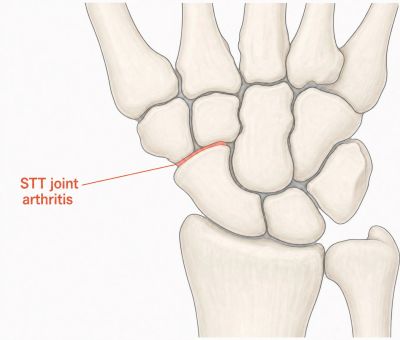
The scaphoid is a small boat-shaped bone in the wrist, on the thumb side. Its far end — the distal pole — meets two other small wrist bones, the trapezium and the trapezoid. Together these three form the scaphotrapeziotrapezoid joint, almost always shortened to the STT joint.
Arthritis of this joint is common. It causes:
- Pain on the thumb side of the wrist, just below the base of the thumb
- Pain that is worse with gripping, pinching, pushing up out of a chair, or twisting a lid or a key
- Swelling and tenderness over the joint
- Sometimes a reduction in wrist movement, and weakness of grip
It can develop on its own, or as a consequence of an old scaphoid fracture that never united.
Why this one is easy to confuse
STT arthritis often occurs alongside arthritis at the base of the thumb, and the two can be very difficult to tell apart from symptoms alone. They sit within a couple of centimetres of each other and they hurt doing the same things.
This matters more than it might sound. Treating the wrong joint will not help, and it is the commonest reason someone has an operation on the thumb base and finds their pain unchanged.
Diagnosis is made from your history and examination together with X-rays, which show the narrowing and wear at the joint. Where the picture is unclear, a local anaesthetic injection into one joint or the other is used to settle the question: if numbing the STT joint takes the pain away, that is where it is coming from.
What to try first
Non-surgical treatment should generally come first, and often works well for a long time:
- A splint supporting the wrist and thumb
- Changing the activities that provoke it, where you can
- Painkillers or anti-inflammatory medication
- Hand therapy
- A steroid injection into the joint, which can settle symptoms for a considerable time
Doing nothing is also a reasonable choice. STT arthritis is not dangerous and symptoms often fluctuate. The trade-off is continuing pain and the limits it places on gripping and thumb use.
The two operations
STT fusion, or arthrodesis, joins the three bones together so the joint no longer moves. It was the standard operation for many years and it reliably removes pain from that joint. The costs are real, though: it requires a long period in plaster while the bones unite, it reduces wrist movement, and it carries a risk of a painful non-union and of arthritis developing later between the scaphoid and the radius.
Distal pole excision removes the worn far end of the scaphoid altogether, so the surfaces can no longer rub. Recovery is much quicker than after fusion — a couple of weeks of protection rather than months in plaster — wrist movement is preserved, there is no metalwork, and there is no risk of a non-union because nothing has to knit together.
Miss Edwards performs distal pole excision for most patients with isolated STT arthritis. Which is right for you is a discussion at your consultation.
What the operation involves
Through a small incision on the front of the wrist, on the thumb side, the joint is opened and the distal quarter of the scaphoid is removed. This leaves a space so that the worn surfaces no longer make contact. In some cases a small amount of soft tissue is placed into the space as a spacer. The ligaments and the sheath over the joint are repaired, and the skin is closed.
Some surgeons perform this operation arthroscopically, through keyhole incisions. Miss Edwards performs it open, through the small incision described above.
It is a day case procedure, carried out under general or regional anaesthetic, and takes around 45 minutes to an hour. The hospital will send you fasting instructions before the day.
What the results look like
These figures come from the published series of this operation (García-Elias et al., 1999; Berkhout et al., 2019):
- Pain relief is good. Most patients were left either completely pain-free or with only occasional mild discomfort.
- Grip strength improved by around a quarter on average.
- Pinch strength improved by around 40% on average.
- Wrist movement is preserved, with a good overall arc of bending and straightening retained.
The published series are small, which is worth knowing when you weigh these numbers.
The risks
Infection at the wound. Injury to nerves or blood vessels near the incision — branches of the radial nerve run close by, and injury can cause numbness or a tender spot. Scar tenderness on the front of the wrist. Continuing or recurrent pain, particularly if there is also arthritis at the base of the thumb that has not been addressed. Flexor tendon problems, including rare reports of a tendon rupturing at the site some time after surgery. The need for further surgery at a later date, including fusion. And complex regional pain syndrome, which is uncommon but recognised.
One risk deserves its own explanation, because you will hear about it if you have an X-ray afterwards.
A change in the alignment of the wrist bones. Removing the end of the scaphoid allows the bone to tilt slightly, and a pattern called DISI can be seen on X-rays afterwards. In the published follow-up this was common — it appeared in around half the wrists — but it did not get worse over time (García-Elias et al., 1999), and it has not been shown to correlate with pain (Berkhout et al., 2019). The longer-term significance is not fully known. It is the main reason some surgeons prefer fusion, and it is a fair thing to ask about.
Recovery
One of the main attractions of this operation over fusion is how short the protected period is: two to three weeks, rather than months.
The first two weeks. You will be in a thumb spica splint or dressing supporting the wrist and thumb — keep it dry. Keep your hand elevated above heart level as much as you can, and use a cold pack wrapped in a cloth for 10 to 15 minutes, two or three times a day. Keep your fingers, elbow and shoulder moving freely throughout.
Two to six weeks. The splint comes off at around two to three weeks and the stitches are removed. Begin gentle wrist and thumb movement, building up as comfort allows, and avoid forceful gripping and heavy lifting for now. Scar management starts once the wound has healed. Most people are back to desk-based work at 2 to 3 weeks, and driving at 3 to 4 weeks.
Six to twelve weeks. Move on to strengthening — therapy putty or a soft ball for grip, pinch exercises, and gradually returning to normal tasks such as opening jars and lifting. Increase the load gradually and stop short of pain. Manual work usually takes 6 to 8 weeks. Hand therapy is often helpful at this stage and will be arranged if it would help you.
Three to six months. Grip and pinch strength continue to improve over several months, and most people reach their final result somewhere in this period.
The full detail, including the risks and the consent discussion, is in the patient information leaflet on this page.
Written by Miss Alison Edwards, Consultant Hand Surgeon. Published September 2026. Next review September 2028.